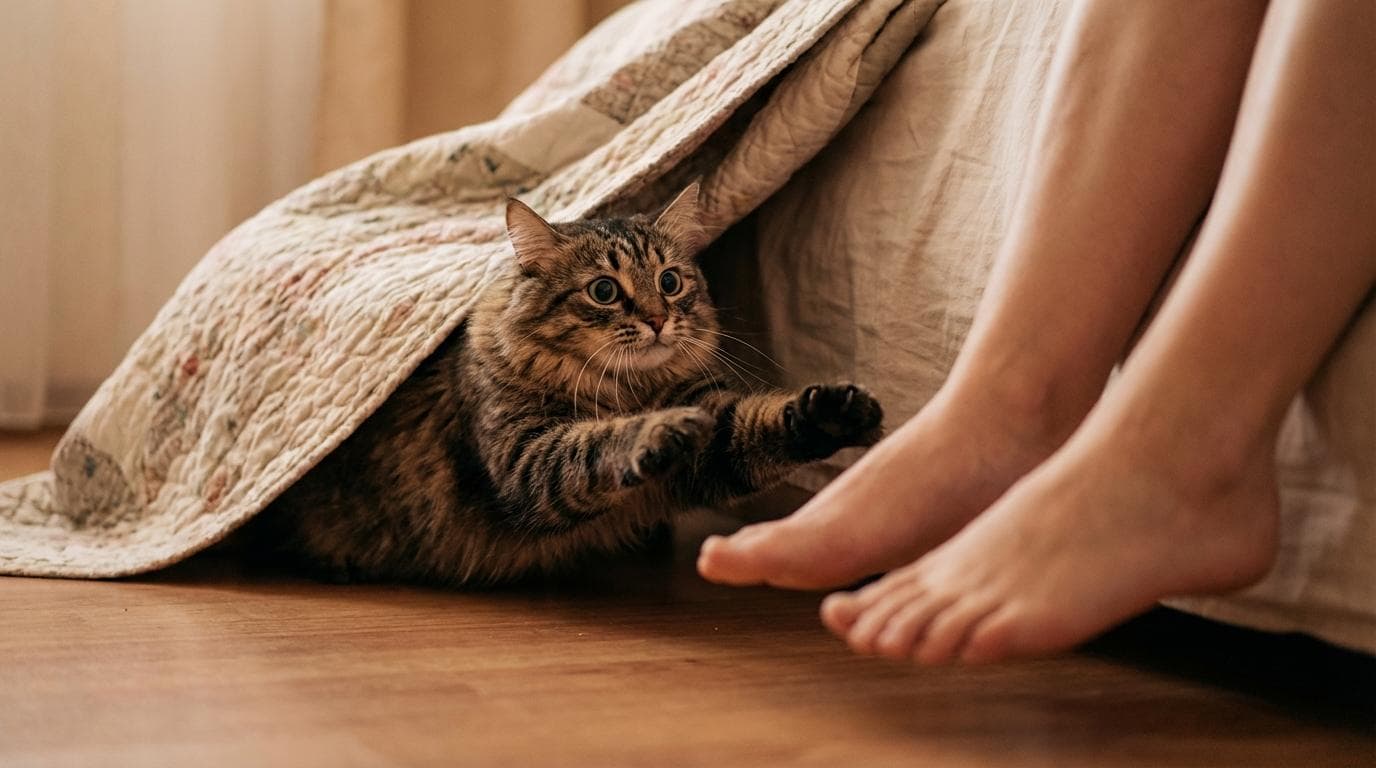
If you think playing with your cat is a nice-to-have bonus that you get to when you have time, you're looking at it backwards. For cats, play isn't entertainment — it's a biological necessity. It's how they express their deepest instincts, maintain physical and mental health, and manage stress. A cat who doesn't play enough will eventually develop problems, guaranteed.
Play Is Hunting Practice
Every time your cat stalks a feather toy, pounces on a crinkle ball, or chases a laser dot, they're running the same neural and muscular pathways they'd use to hunt prey in the wild. The sequence is always the same:
1. Detect — ears perk, eyes lock onto target
2. Stalk — body low, slow approach, tail tip twitching
3. Chase — burst of speed, focused pursuit
4. Pounce — the leap, claws extended
5. Catch — the grab, the bite, the kill shake
6. Consume — in play, this translates to carrying the toy away
When we interrupt this sequence or never let it complete, we create frustration. This is why laser pointers — used alone — can actually increase anxiety in some cats. They complete every step except the catch, which is the most rewarding part. Always end laser play with a physical toy they can actually grab.
How Much Play Does Your Cat Need?
Minimum: two interactive play sessions of 10 to 15 minutes per day. But this varies enormously based on your cat's age, personality, and archetype.
Kittens (under 1 year): Three to four sessions of 15 minutes. They have seemingly unlimited energy and need constant outlets.
Young adults (1 to 7 years): Two to three sessions of 10 to 15 minutes. The sweet spot for most cats.
Mature adults (7 to 10 years): Two sessions of 10 minutes. They may be less intense but still need the stimulation.
Seniors (10+ years): One to two shorter sessions of 5 to 10 minutes. Gentler play with easier-to-catch prey. They still need it.
Cats with the Overstimulated Hunter archetype often need significantly more play than average — these are the cats who will destroy your house if you only play with them for 5 minutes a day. They have intense prey drives and high energy that requires dedicated, structured outlets.
The Right Way to Play
Wand Toys Are King
Wand toys (also called fishing pole toys, teaser wands) are the single best play tool because you control the "prey" movement. This lets you mimic realistic prey behavior.
How to move the toy like prey:
- Move it AWAY from your cat, not toward them (prey runs away from predators)
- Use erratic, unpredictable movements
- Pause periodically (prey stops to listen)
- Let it hide behind furniture or under paper (prey hides)
- Move it at different speeds (a mouse scurries, a bird hops)
- Let your cat catch it regularly (they need the reward of success)
Variety Matters
Cats have prey preferences. Some prefer feathered toys (bird hunters), some prefer fur-covered mice (rodent hunters), and some prefer snake-like toys that slither on the ground. Experiment to find what triggers your cat's most intense hunting response.
Rotation Prevents Boredom
Leaving all toys out all the time makes them boring. Rotate toys weekly — put some away and bring out "new" ones. The novelty triggers renewed interest.
Solo Play Options
Interactive play with you is most valuable, but your cat also needs self-play options for when you're busy or away:
- Crinkle balls and lightweight toys they can bat around
- Catnip toys (refresh the catnip every few weeks)
- Automated toys that move unpredictably
- Puzzle feeders (hunting for food)
- Paper bags and cardboard boxes (free and beloved)
The Hunt-Eat-Groom-Sleep Cycle
This is the single most important concept in cat play. In nature, the sequence is always: hunt, catch, eat, groom, sleep. Your play sessions should follow this pattern.
1. Play vigorously for 10 to 15 minutes (the hunt)
2. Let your cat catch the toy at the end (the catch)
3. Immediately offer a meal or substantial treat (the eat)
4. Your cat will naturally groom themselves
5. Your cat will naturally fall asleep
Following this cycle before bedtime is the most effective strategy for preventing nighttime activity. You're working with their biology instead of against it.
Signs Your Cat Isn't Getting Enough Play
- Attacking your ankles, feet, or hands
- Excessive zoomies, especially at night
- Destructive scratching on furniture
- Weight gain
- Bullying other cats in the household
- Excessive grooming or hair pulling
- General restlessness or hyperactivity
- Knocking things off surfaces
- Increased vocalization and attention-seeking
Play Mistakes to Avoid
Using Your Hands as Toys
This teaches your cat that human skin is an acceptable target. It's cute when they're kittens. It's not cute when they're adults with full-sized claws and teeth.
Punishing Play Aggression
If your cat redirects play energy onto you, don't yell or squirt water. Simply end the interaction and walk away. Redirect with an appropriate toy next time.
Only Using Laser Pointers
Lasers provide the stalk and chase but never the catch. Used exclusively, they can create frustration and anxiety. Always end laser sessions by pointing the dot at a physical toy your cat can grab.
Playing Too Roughly
Some cats get overstimulated during intense play and transition from play mode to genuine aggression. If your cat's body language shifts from playful to aggressive (ears back, body tense, hard stare), end the session immediately. Learn your cat's threshold and stay below it.
Inconsistency
Playing vigorously for a week and then stopping for a month is worse than a consistent moderate schedule. Your cat's energy and behavioral equilibrium depend on regular, predictable play.
Match Play to Your Cat's Archetype
Different behavioral types need different play approaches. An anxious cat needs slow, predictable play that builds confidence. A high-energy hunter needs intense, vigorous sessions. A clingy cat benefits from play that builds independence.
Generic play advice helps, but targeted strategies based on your cat's specific behavioral profile are transformative. Take the free cat archetype quiz to identify your cat's play style, energy level, and specific enrichment needs. The right play protocol can change your cat's behavior dramatically — often within days.