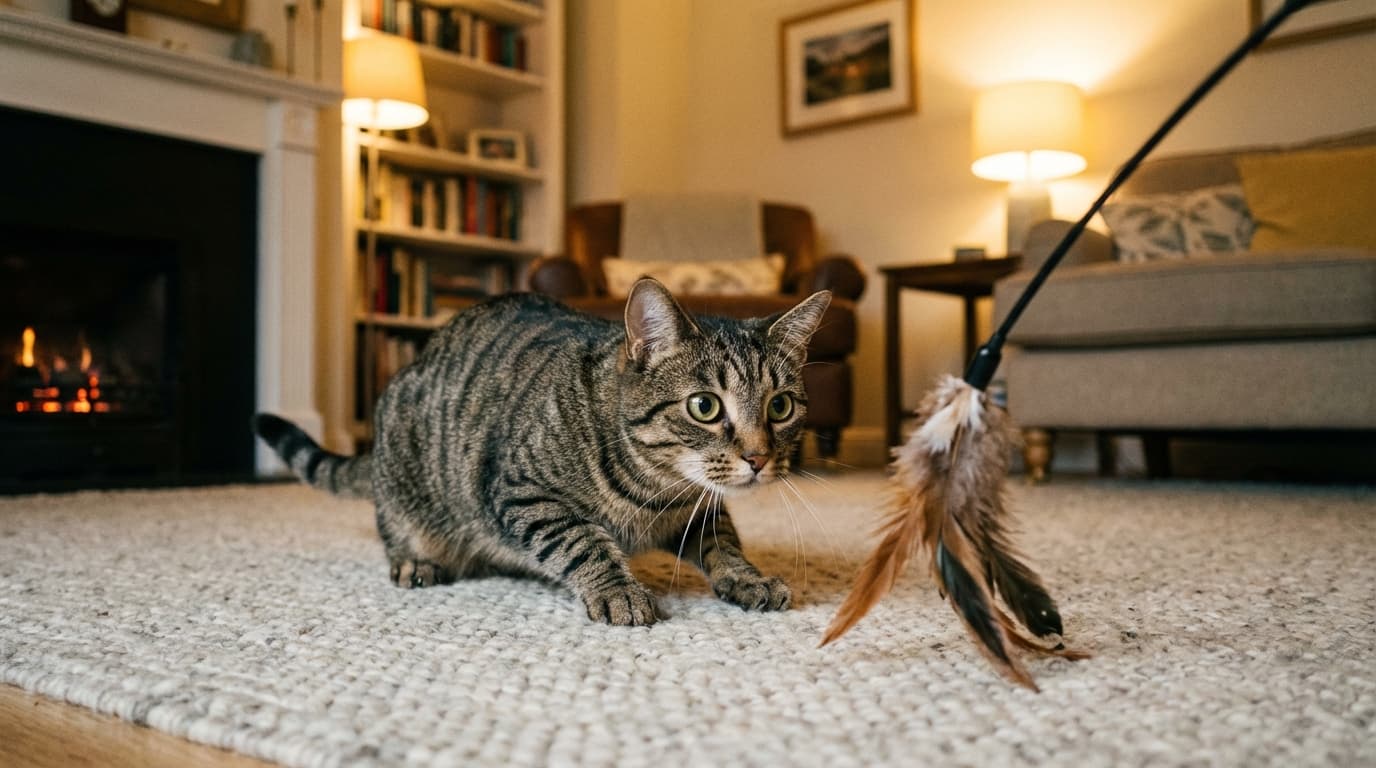
Your cat crouches low, pupils wide, tail twitching with electric focus. In a split second, she launches across the room at a crumpled receipt — not because she's bored or misbehaving, but because every fiber of her being is wired for indoor cat hunting. Understanding this drive is the first step to building a life your wild-at-heart cat actually thrives in. This article walks through exactly what the prey drive demands, and how to meet it practically — every single day.
The Hunt-Catch-Kill-Eat Cycle: What Your Cat Needs
Domestic cats retain the full predatory sequence of their wild ancestors. This cycle has four distinct stages: stalking and hunting, the chase, the catch and kill, and finally eating. When indoor cats are denied the opportunity to complete this sequence, it doesn't simply disappear — it finds other outlets. Midnight zoomies, obsessive staring at walls, ankle ambushes, and even destructive behavior are often symptoms of an unsatisfied cat hunting instinct.
The critical insight most cat owners miss is that all four stages matter equally. Providing food without the hunt leaves cats in a state of perpetual low-level frustration. A cat who never gets to stalk, chase, or catch is like an athlete who trains intensively but is never allowed to compete — physically capable but psychologically restless. Over time, this frustration can contribute to anxiety, aggression toward people or other pets, and compulsive behaviors like excessive grooming.
Wild cats spend roughly four to six hours each day engaged in hunting activity. They don't always succeed, but the engagement itself is essential. Replicating that engagement indoors — even imperfectly — makes a profound difference in a cat's daily wellbeing.
Wand Toys and Puzzle Feeders: Your Two Most Powerful Tools
No enrichment tool comes closer to replicating real prey behavior than a quality wand toy. The feathers, ribbons, or lures at the end move unpredictably, triggering the same neural pathways activated by a moving mouse or bird. When you animate a wand toy with darting, erratic movements — pausing, retreating, hiding behind furniture, then reappearing — your cat's predatory brain lights up completely.
Effective wand play follows a specific rhythm. Start slowly to mimic a resting or unaware animal. Gradually increase energy and speed to simulate fleeing prey. Always allow your cat to catch the toy regularly — this is crucial. A cat that never catches anything becomes frustrated and may give up entirely. End each session by letting her hold and bunny-kick the lure, completing the kill phase of the cycle. Two to three sessions of ten to fifteen minutes each day is significantly more effective than one long session, and timing them around dawn and dusk aligns with the crepuscular peaks when your cat's prey drive naturally surges.
Puzzle feeders address the eating end of the cycle. By hiding dry food or small treats in puzzle boards, rolling food balls, or snuffle mats, you require your cat to work for each piece of kibble — replicating the foraging effort a wild cat expends before any meal. This cat enrichment hunting approach also slows eating, which benefits digestion and reduces the bored overeating common in sedentary house cats. Start with an easy puzzle where food is only partially hidden, then increase difficulty as your cat builds confidence and skill over several weeks.
Toy Rotation: Keeping the Cat Prey Drive Sharp
Cats habituate to toys quickly. A toy that triggered intense stalking behavior on Monday may be completely ignored by Friday. This is not boredom in the human sense — it is a hardwired response to novelty. In the wild, the same piece of ground does not yield unlimited prey. A cat's hunting brain is primed to seek new opportunities, and static toys register as dead prey that holds no further interest.
The solution is systematic rotation. Keep a collection of eight to twelve toys and cycle them in groups of three or four every three to four days. Store unused toys in a sealed drawer or container where your cat cannot see or smell them easily. When a toy reappears after a week's absence, it registers as novel again, reigniting the cat prey drive response in full.
This same principle applies to wand toy attachments. Rotating between feather lures, ribbon attachments, crinkle balls, and small plush mice keeps sessions genuinely engaging and prevents the habituation that makes play feel stale within days. A small investment in variety pays large dividends in sustained, enthusiastic engagement across months and years.
Designing Your Home for Indoor Cat Hunting
The physical layout of your home can either support or suppress your cat's indoor cat hunting behavior. Cats are ambush predators who need vertical space to survey territory, hidden spots to stalk from, and clear sightlines to track prey. A flat, open apartment with no furniture variation offers very little stimulation for a wild-at-heart cat.
Cat trees and wall-mounted shelving allow cats to observe the room from elevated positions — exactly what a hunting cat needs when scanning for movement below. Cardboard boxes with entry holes cut in them, paper bags with handles removed, and collapsible fabric tunnels provide the stalking cover that transforms an ordinary living room into a functioning hunting environment. Consider positioning these structures near windows so your cat can move between observation posts and stalking cover just as she would in a complex outdoor landscape.
Window perches positioned near bird feeders or squirrel activity outside provide hours of visual stimulation, even if the cat can never actually catch the animals she watches. Designate certain areas of your home as hunting zones where you regularly scatter treats or hide small toys, rotating these zones periodically so the space never feels predictably prey-free.
Session Timing and the Final Meal: Completing the Cycle
The hunt-catch-kill-eat cycle ends with eating — and this detail matters more than most owners realize. When indoor cats complete an energetic play session without a feeding component, the predatory cycle remains physiologically unfinished. The body is primed for a caloric reward that never arrives. Over time, this incomplete cycle contributes to restlessness after play sessions rather than the calm, satisfied torpor owners often expect.
Many cat behaviorists recommend scheduling the last meal of the day immediately after the final evening play session. This sequence — hunt, catch, eat, groom, sleep — mirrors exactly what a wild or outdoor cat would experience after a successful hunt, and it produces a deeply satisfied, calm cat who is genuinely ready for rest. The wild-at-heart archetype shows intense focus during play, rapid recovery to full energy after exhausting sessions, and genuine restlessness when under-stimulated throughout the day. These cats need a structured daily routine that treats the complete hunt-catch-kill-eat cycle as non-negotiable rather than optional enrichment.
This approach also addresses one of the most common complaints from cat owners: the 3 a.m. wake-up. A cat whose predatory cycle has been completed before bed is far more likely to sleep through the night.
Take the free quiz to discover your cat's specific archetype and get personalized enrichment recommendations built around her exact prey drive profile — because a well-matched enrichment program doesn't just keep a cat occupied, it meets her at the level of who she actually is.
Further Reading
- Feline Behaviour Problems: Indoor Enrichment — International Cat Care offers evidence-based guidance on managing the behaviour of indoor cats and providing appropriate enrichment.
- Cat Enrichment — The ASPCA's resource on indoor versus outdoor cats covers the importance of environmental enrichment for satisfying natural feline instincts safely.