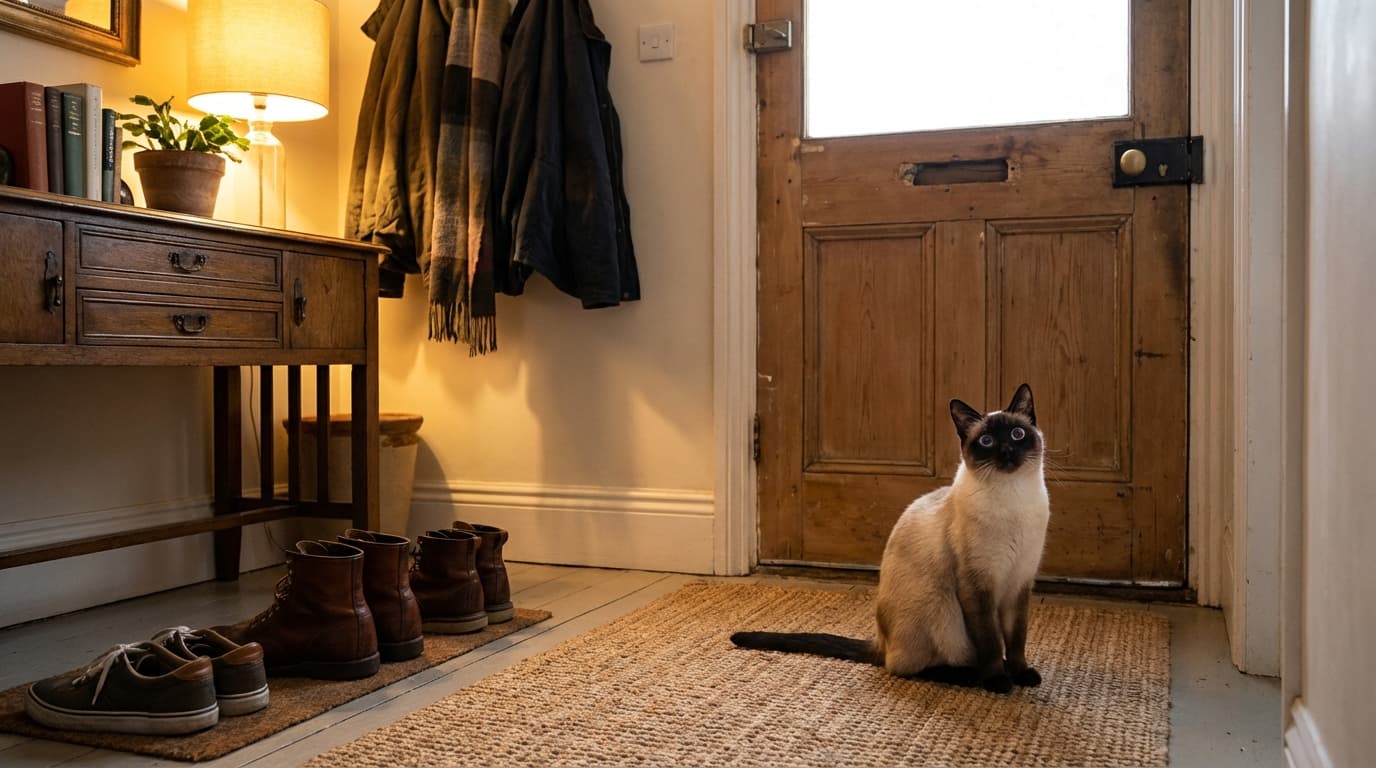
If you have ever walked into a room only to find your cat already there, staring at you from the doorway, you are not imagining things. Some cats form such intense bonds with their owners that any separation, even a quick trip to the bathroom, triggers genuine distress. The question of whether cats get separation anxiety has a clear answer: yes, they absolutely can. The velcro shadow cat is one of the most commonly misunderstood feline personalities, and understanding this behavior is the first step toward helping your cat feel safe even when you are not in the room.
For decades, cats were dismissed as aloof, independent creatures who tolerated humans only for food. That myth has been thoroughly debunked by modern feline behavioral science. Cats form secure attachments to their caregivers in much the same way dogs and human infants do. A 2019 study published in Current Biology found that roughly 65 percent of cats displayed secure attachment styles toward their owners. The remaining cats showed insecure attachments, and it is within this group that separation anxiety tends to emerge most intensely. The velcro shadow cat often falls into the anxious-ambivalent attachment category, craving closeness but struggling to self-soothe when left alone.
What Cat Separation Anxiety Actually Looks Like
Separation anxiety in cats does not always present as dramatic howling at the door, though that certainly happens. The signs can be subtle and easy to miss if you do not know what to look for. A cat with separation anxiety might begin excessive grooming when you pick up your keys, pulling out fur in patches along the belly or inner legs. Others stop eating entirely when their person is away, only to devour food the moment the owner returns. Inappropriate elimination is another hallmark, where a perfectly litter-trained cat begins urinating on your bed, your clothes, or near the front door. These are not acts of spite. They are stress responses from a cat whose nervous system is in overdrive.
Other common signs include destructive behavior like scratching furniture or knocking items off counters, vocalizing loudly and persistently after you leave, following you from room to room when you are home, and greeting you with an intensity that seems disproportionate to the time you were gone. If your cat meows excessively when you leave, paces near exits, or seems unable to settle unless physically touching you, separation anxiety is the likely explanation. Take the free cat archetype quiz to understand whether your cat fits the velcro shadow profile and learn what drives their clingy behavior.
Why the Velcro Shadow Cat Is Wired This Way
Not every cat develops separation anxiety. The velcro shadow archetype describes cats whose core personality revolves around human connection. These cats are not simply affectionate; they are emotionally dependent on proximity to their chosen person. This dependency is shaped by a combination of genetics, early life experiences, and environmental factors that create a cat who genuinely cannot regulate their emotions without the presence of their human anchor.
Kittens who were weaned too early, before seven or eight weeks of age, are significantly more likely to develop anxious attachment styles. Without adequate time learning social coping skills from their mother and littermates, these cats grow up lacking the internal resources to self-soothe. Similarly, cats who were hand-raised as orphaned neonates often bond intensely to their human caregiver because that person literally became their survival figure. Breed also plays a role. Siamese, Burmese, and Ragdoll cats are genetically predisposed to forming stronger human attachments, and separation anxiety is notably more common in these breeds.
Life changes can also trigger or worsen separation anxiety in cats who were previously stable. A move to a new home, a change in work schedule that means longer absences, the loss of another pet companion, or even rearranging furniture can destabilize a velcro shadow cat. Their world is anchored to routine and to you, and when either shifts, anxiety floods in.
How to Help a Cat With Separation Anxiety
Helping a velcro shadow cat manage separation anxiety is not about making them less attached to you. The goal is to build their confidence and teach them that being alone is safe, not threatening. This requires patience and consistency, but the results can be transformative for both the cat and the owner.
Environmental enrichment is the foundation of any separation anxiety management plan. A cat who has nothing to do while you are gone will fixate on your absence. Puzzle feeders that dispense kibble when batted around give your cat a task that engages their predatory brain. Rotating toys keeps the environment novel, since cats lose interest in objects that are always available. Window perches positioned near bird feeders provide hours of visual stimulation. Leaving a radio or television on at low volume can also help, as the background noise mimics the ambient sounds of an occupied home.
Graduated departures are another effective strategy. If your cat panics every time you leave, start by stepping outside the front door for thirty seconds, then returning calmly without making a fuss. Gradually increase the duration over days and weeks. The key is to make departures and arrivals boring. Dramatic goodbyes and enthusiastic hellos reinforce the idea that your absence is a significant, stressful event. By keeping transitions low-key, you teach your cat that people leaving and returning is simply part of the day, not a crisis.
Creating a safe space for your cat can also make a significant difference. This might be a cozy enclosed cat bed in a quiet room, a cardboard box with a blanket inside, or a high shelf where they can retreat and feel secure. Cats who have a dedicated space that smells like them and feels protected are better equipped to manage stress during your absence. Adding an item of your worn clothing to this space gives your cat access to your scent, which can be genuinely calming for an anxiously attached cat.
When Separation Anxiety Needs Professional Help
Not all cases of cat separation anxiety can be resolved with enrichment and graduated departures alone. If your cat is pulling out fur to the point of creating bald patches, refusing food for extended periods, or eliminating outside the litter box despite a clean bill of health from the veterinarian, it is time to seek professional support. A veterinary behaviorist can assess whether medication might help your cat while behavioral modification techniques take effect. Anti-anxiety medications like fluoxetine or gabapentin are sometimes prescribed for cats with severe separation distress, and they can be genuinely life-changing when used alongside environmental and behavioral strategies.
It is also worth noting that what looks like separation anxiety can sometimes have a medical cause. Hyperthyroidism, urinary tract infections, and cognitive dysfunction in older cats can all produce symptoms that mimic anxiety. A thorough veterinary exam should always be the first step before assuming the problem is purely behavioral.
Building a Calmer Life for Your Velcro Shadow Cat
Living with a velcro shadow cat is not a burden when you understand what drives their behavior. These cats love deeply, and their attachment to you is genuine. The challenge is helping them develop enough internal security that your temporary absence does not feel like abandonment. With the right combination of enrichment, routine, graduated independence training, and professional guidance when needed, most velcro shadow cats can learn to rest comfortably while you are away and greet you warmly, not desperately, when you return.
If you are not sure whether your cat is a true velcro shadow or simply an affectionate cat who enjoys your company, take the free cat archetype quiz to find out. Understanding your cat's core behavioral profile is the most important step you can take toward building a relationship that works for both of you.
Further Reading
- Separation Anxiety in Cats from the ASPCA provides an overview of symptoms and management strategies.
- Keeping Your Cat Happy from International Cat Care covers enrichment strategies that reduce anxiety and improve feline wellbeing.