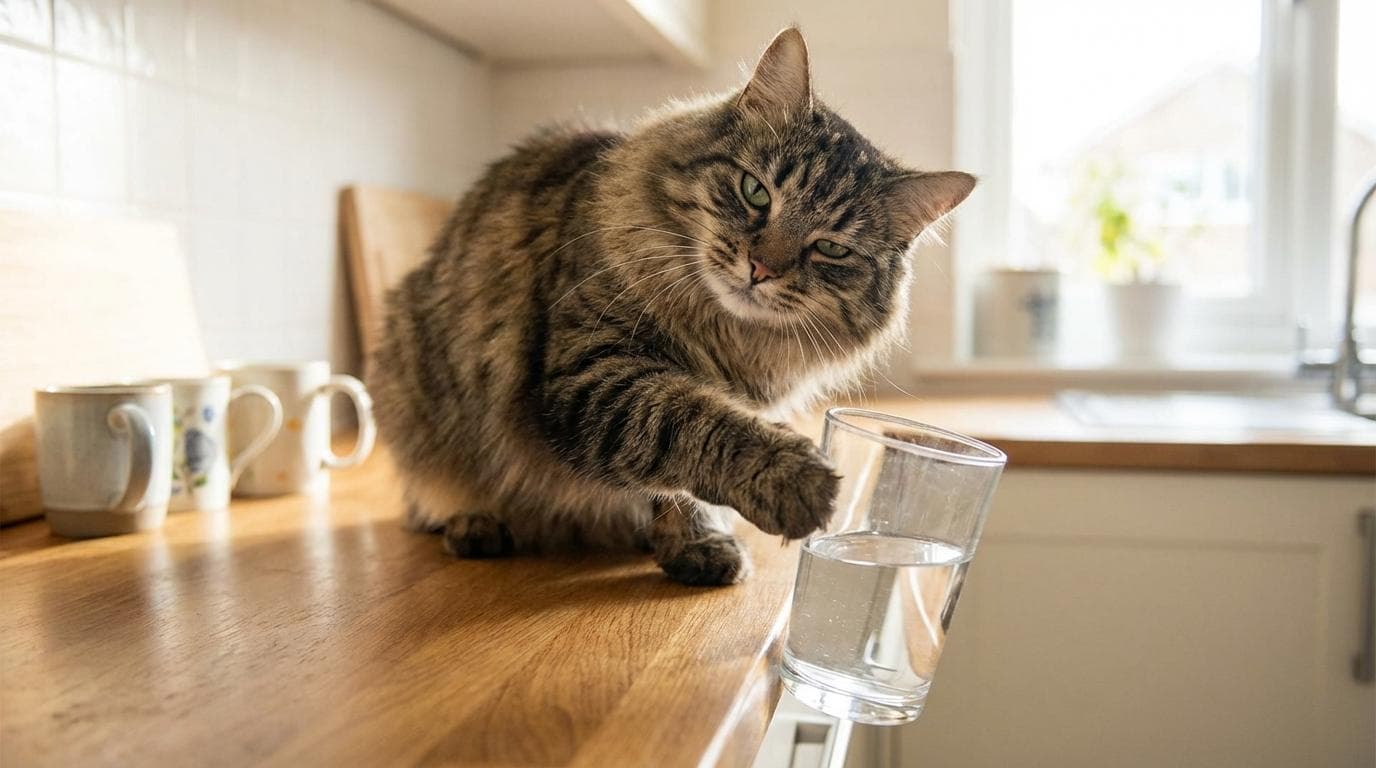
You set your coffee mug on the table, turn your back for two seconds, and hear the unmistakable crash. Your cat sits there, paw still extended, staring at you with what can only be described as zero remorse. Sound familiar?
This behavior drives cat owners absolutely crazy, and it's one of the most searched cat behavior questions on the internet. But here's the thing — your cat isn't doing this to annoy you. There's actually a fascinating explanation rooted in their predatory instincts.
The Hunting Instinct Behind the Swipe
Cats are hardwired predators. In the wild, they use their paws to test whether prey is alive or dead, edible or dangerous. When your cat bats at your water glass, they're engaging the exact same neural pathways they'd use to investigate a mouse or a beetle.
Their paws are incredibly sensitive — packed with nerve endings that give them detailed information about an object's weight, texture, and movement potential. When they tap your phone off the counter, they're essentially running a predatory assessment on it.
This behavior is especially common in cats who don't get enough hunting simulation in their daily lives. If your cat has a strong prey drive but spends most of their time indoors without adequate stimulation, those hunting instincts have to go somewhere.
It's Also About Getting Your Reaction
Let's be honest — what happens when your cat knocks something off the table? You react. You jump up, you say their name, you might even chase them. From your cat's perspective, they just discovered a foolproof way to get your immediate, undivided attention.
Cats are much more socially aware than people give them credit for. They learn cause and effect remarkably quickly. If knocking your keys off the counter gets you to look at them, talk to them, or interact with them in any way, they've just been reinforced for doing it again.
The Overstimulated Hunter Connection
This behavior is particularly common in cats who fit the Overstimulated Hunter archetype. These cats have intense prey drives and are easily triggered by movement, sounds, and environmental stimuli. They need more engagement than the average cat, and when they don't get it, they create their own entertainment.
Signs your cat might be an Overstimulated Hunter:
- They knock things off surfaces regularly
- They attack your feet under blankets
- They get the "zoomies" frequently
- They seem to go from calm to frantic in seconds
- They stare intensely at birds through windows
What You Can Do About It
Understanding why your cat does this is the first step. Here's how to redirect the behavior:
Increase Interactive Play
Schedule two 15-minute play sessions daily using wand toys that mimic prey movement. Let your cat stalk, chase, pounce, and "catch" the toy. End each session with a treat so they experience the full hunt-catch-eat cycle.
Provide Puzzle Feeders
Instead of putting kibble in a bowl, use puzzle feeders that make your cat work for their food. This engages their problem-solving instincts and gives them a productive outlet for paw manipulation.
Secure Valuable Items
This one's practical — if you know your cat targets certain surfaces, keep breakables out of reach. It's not giving in to bad behavior; it's smart environmental management.
Don't Reward the Behavior
The hardest part: when your cat knocks something off, try not to react. Pick it up without making eye contact or talking to them. If they're doing it for attention, removing the reaction removes the reward.
Add Vertical Space
Cat shelves, tall cat trees, and window perches give your cat approved high surfaces to explore with their paws. Cats feel more secure when they have vertical territory, which can reduce attention-seeking behaviors.
When It's More Than Just Play
Sometimes excessive object-batting can signal that your cat is genuinely understimulated or stressed. If your cat is also showing other signs like over-grooming, appetite changes, or increased vocalization, the knocking behavior might be part of a larger behavioral pattern.
Every cat has a unique behavioral profile that influences how they interact with their environment. Understanding your cat's specific archetype can help you address not just the surface behavior, but the underlying needs driving it.
Find Out What's Really Going On
If your cat's table-clearing habit is just one of several puzzling behaviors, it might be time to look at the bigger picture. Take the free cat archetype quiz to discover your cat's unique behavioral profile and get personalized strategies that actually work for their specific personality type.
Your cat isn't being difficult — they're being a cat. Once you understand the "why" behind their behavior, the solutions become much clearer.
Remember, the impulse to knock things off surfaces is deeply connected to your cat's hunting wiring. Rather than fighting against it, channel that energy into appropriate outlets. A cat whose predatory needs are met is a cat who leaves your coffee mug alone — most of the time.