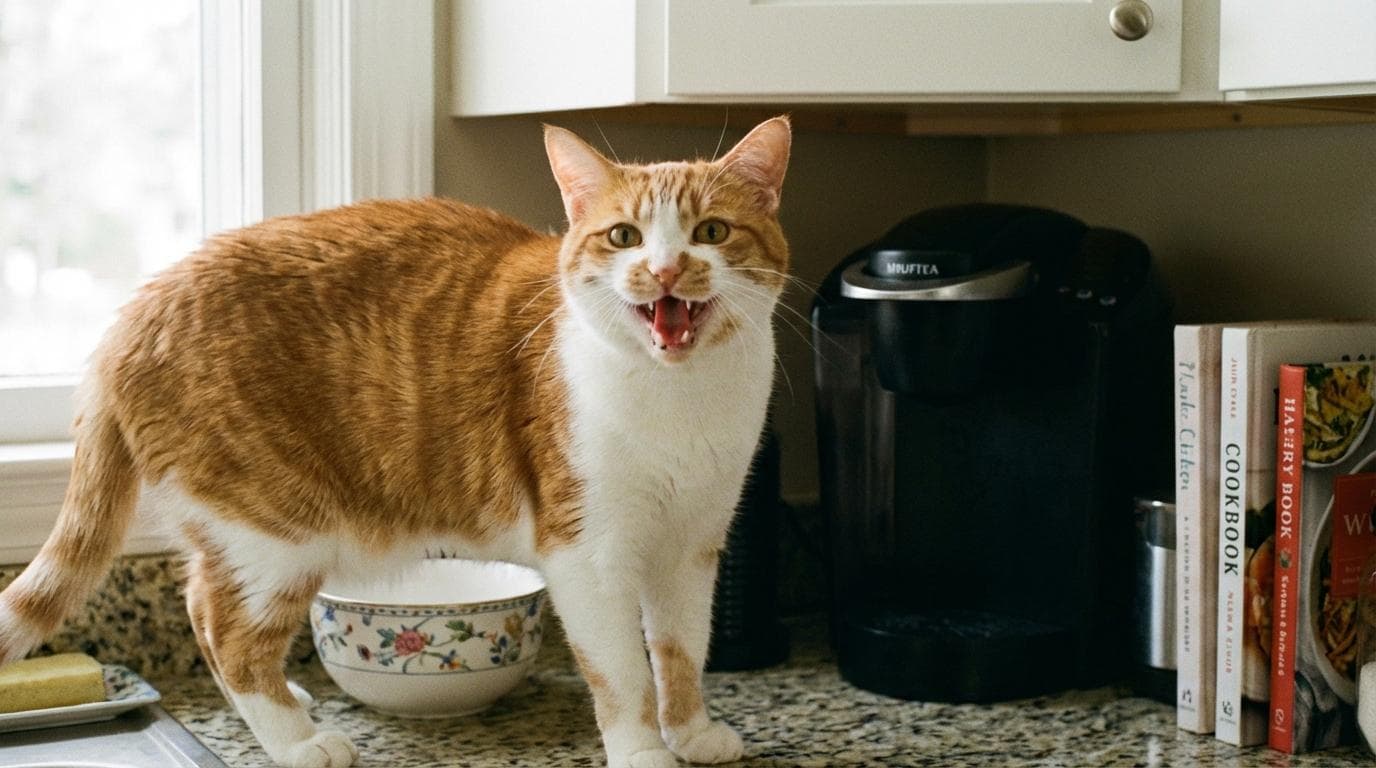
Your cat stands in the hallway and meows at nothing. They meow at you when you're trying to work. They meow at 4 AM. They meow when you're in the bathroom, when you're cooking, when you sit down, when you stand up. It's relentless, and you're losing your mind.
Before you invest in earplugs, understand this: adult cats rarely meow at other cats. Meowing is a behavior they developed specifically for communicating with humans. When your cat meows at you, they're talking to you. The question is: what are they saying?
The Surprising Truth About Cat Meowing
Kittens meow to their mothers. Once they grow up and leave the litter, cats almost exclusively communicate with other cats through body language, scent marking, and hissing or growling. The meow is reserved for us.
This means your cat's meowing is learned behavior. They've discovered that vocalizing gets a response from their human — food appears, doors open, attention is given. And different meows have been shaped through your interactions into a personalized vocabulary.
Research has shown that cat owners can identify their own cat's meows with about 40% accuracy across different contexts (hungry, greeting, frustrated) — significantly better than strangers. You've unknowingly learned some of your cat's language already.
8 Reasons Your Cat Meows Excessively
1. They Want Food
The most common reason. If your cat meows around feeding time, near the kitchen, or when they hear the rustle of treat bags, this is a food demand.
Solution: Feed on a consistent schedule. Don't respond to meowing with food — this rewards the behavior. Wait for a moment of quiet, then feed. Consider an automatic feeder that takes you out of the equation entirely.
2. They Want Attention
Some cats meow because they want interaction — play, petting, or simply your presence in the same room. This is especially common in Velcro Shadow types who are deeply bonded to their person and derive security from closeness.
Solution: Ensure you're providing adequate attention and play daily. But don't respond to demanding meows — wait for quiet, then engage. Rewarding meowing teaches more meowing.
3. They Want In or Out
Standing at a door and meowing is one of the most universal cat behaviors. They want access to a room, the outdoors, or wherever you are.
Solution: If they want a specific room, consider leaving the door open or installing a cat door. If they want outdoors, provide alternative stimulation (window perch, catio, supervised outdoor time).
4. They're Greeting You
Many cats meow when their person comes home, wakes up, or enters a room. This is a friendly greeting — the cat equivalent of "hey, you're back."
Solution: This doesn't need fixing. Acknowledge the greeting briefly and move on. It usually stops quickly once the greeting ritual is complete.
5. They're Stressed or Anxious
Anxiety-driven meowing is often lower-pitched and more persistent than attention-seeking meows. It may happen during storms, when strangers visit, after household changes, or when routine is disrupted.
Solution: Identify and address the stressor. Provide safe spaces, maintain routines, and consider pheromone diffusers. If the anxiety is severe, consult your vet.
6. They're in Pain or Sick
A cat who suddenly starts meowing more than usual, especially with a different tone or quality of meow, may be in pain or feeling ill. This is particularly concerning in older cats.
Warning signs to see a vet:
- New or changed vocalization pattern
- Meowing accompanied by lethargy, appetite change, or litter box issues
- Meowing when using the litter box (could indicate urinary pain)
- Meowing when jumping or being picked up (could indicate joint or abdominal pain)
- Overnight meowing in a senior cat (could indicate cognitive decline or hyperthyroidism)
7. They're a Chatty Breed
Some breeds are genetically predisposed to vocalization. Siamese, Oriental, Burmese, Bengal, and Tonkinese cats are known for being exceptionally vocal. If you have one of these breeds, frequent meowing is just part of the package.
Solution: Learn to enjoy the conversation. You can't train breed-specific vocalization out of a cat. You can, however, avoid reinforcing excessive meowing by not responding to every vocalization.
8. Cognitive Decline in Senior Cats
Older cats with Cognitive Dysfunction Syndrome often meow more, especially at night. They may seem confused, disoriented, or distressed during these episodes.
Solution: See your vet for a CDS evaluation. Night lights can help disoriented cats navigate. Maintain consistent routines. Your vet may recommend supplements or medications.
What NOT to Do
Don't Yell Back
Yelling at a meowing cat doesn't stop the meowing — it adds to the noise and stresses your cat out. They don't understand that you're telling them to be quiet. They just know you're making loud noises too, which might mean you're responding.
Don't Punish
Spraying water, making loud noises, or physically pushing your cat away will damage your relationship and increase anxiety-based meowing. Punishment doesn't teach cats what TO do.
Don't Give In
If your cat meows for food and you eventually feed them after 10 minutes of meowing, you've taught them that persistence works. You haven't just rewarded meowing — you've rewarded sustained meowing, which is worse.
Don't Ignore Medical Possibilities
Always rule out health issues before assuming meowing is purely behavioral. A vet checkup is especially important if the meowing is new, different in character, or accompanied by any other behavioral or physical changes.
Building Better Communication
The goal isn't to silence your cat — it's to understand them well enough that excessive meowing becomes unnecessary. When you can read their body language, anticipate their needs, and provide adequately for them, much of the meowing resolves naturally.
Every cat has a unique communication style shaped by their personality archetype. Understanding your cat's specific communication patterns, needs, and behavioral drivers is the key to reducing unwanted vocalization while strengthening your bond.
Take the free cat archetype quiz to discover your cat's behavioral profile and get personalized strategies for understanding and responding to their communication. When you and your cat finally speak the same language, everyone sleeps better.